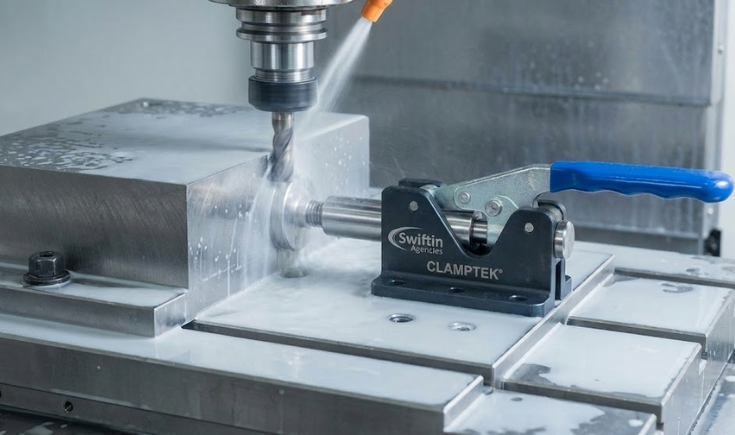
How to Choose the Correct Toggle Clamp for Your Welding Fixtures
Designing a welding fixture is very different from designing a machining jig. In a welding environment, your tools are exposed to intense heat, flying molten spatter, and aggressive smoke. A standard toggle clamp that works perfectly on a drill press will likely fail within a week on a welding table.
At Swiftin Agencies LLP, we often see manufacturers in Pune and across India struggle with clamps jamming or handles melting. The key to reducing downtime is selecting the right tool for the environment.
Here are the critical factors to consider when choosing Clamptek Toggle Clamps for your welding operations.
1. Fight the Spatter: Copper Plated Spindles
The number one enemy of a welding clamp is weld spatter. These tiny droplets of molten metal fly off the arc and land on the clamp's threaded spindle. Once they cool and harden, they fuse to the threads. The next time the operator tries to adjust the clamp, it jams.
The Solution: Always specify clamps with Copper-Plated Spindles.
- Copper has excellent thermal conductivity and a surface chemistry that prevents steel spatter from adhering.
- Even if spatter lands on the spindle, it can be easily wiped off without damaging the threads, ensuring long-term adjustability.
2. Material Matters: Black Oxide Finish
Bright zinc-plated clamps look good, but in a welding cell, they can sometimes reflect arc light or suffer from corrosion due to welding fumes.
Clamptek’s Weldable Series typically comes with a Black Oxide finish. This chemical conversion coating not only reduces light reflection (helpful for automated optical inspection sensors) but also provides a surface that spatter finds difficult to stick to compared to bare steel.
3. Accessibility: Vertical vs. Horizontal Design
In manual welding, the operator needs room to maneuver the welding torch (MIG gun).
- Vertical Clamps: The handle stands upright when locked. This is great for saving space on the fixture base, but be careful it doesn't block the welder's hand path.
- Horizontal Clamps: The handle lies flat when locked. These are generally preferred for welding fixtures as they keep a low profile, reducing the risk of accidental contact with the hot torch.
4. The "Solid Bar" Advantage
For heavy-duty welding, avoid "U-Bar" clamping arms if possible. While U-Bars are adjustable, they can flex under extreme heat.
Solid Bar Clamps (with a bolt retainer welded on) offer superior rigidity. They act as a heat sink, absorbing thermal energy from the workpiece without deforming. This ensures your parts stay aligned even as they expand during the welding process.
Conclusion: Invest in LongevityDon't let a Rs. 200 standard clamp ruin a production run worth lakhs. By choosing Clamptek clamps specifically designed for welding—featuring copper spindles and solid bars—you ensure your fixtures last longer and your operators work faster.
Looking for welding clamps in India? Swiftin Agencies maintains a large stock of high-temperature, spatter-resistant clamps ready for immediate dispatch.
Browse our catalog at www.toggleclampsindia.com or contact us for technical advice on your next fixture build.
 FAQ’s
FAQ’s